> For the complete documentation index, see [llms.txt](https://mobs.advancedplugins.net/llms.txt). Markdown versions of documentation pages are available by appending `.md` to page URLs; this page is available as [Markdown](https://mobs.advancedplugins.net/advancedmobs/mechanics/build-mobs-with-blocks.md).
# Build Mobs With Blocks
Use your own patters to build bosses
## How do block patterns work?
Building mobs with block patterns mimics the vanilla feature where Withers, Iron golems or snowmans can be built. Players must make a specific pattern for a mob to spawn - the block pattern disappears. Best explained by this gif:
## How to customize / make your own patterns?
You will need to do this all inside `plugins/AdvancedMobs/bosses` folder. If you are customizing an already available pattern, find the file named same as the mob you want to change, otherwise, create a new file called `.yml`, example: `Wyvern.yml`
We're going to be customizing a default pattern of Wyvern mob. The inside of file looks like this:
{% code title="plugins/AdvancedMobs/bosses/Wyvern.yml" overflow="wrap" lineNumbers="true" %}
```yaml
# Boss Configuration file for Wyvern
# How to build Wyvern boss
build:
pattern:
- ' e '
- 'idi'
- ' d '
materials:
e: ENCHANTING_TABLE
i: IRON_BLOCK
d: REINFORCED_DEEPSLATE
```
{% endcode %}
Patterns are very simple to understand. Use empty space to act as an AIR block, otherwise specify material names below the pattern list. As an example, in our file, `e` means ENCHANTING\_TABLE.
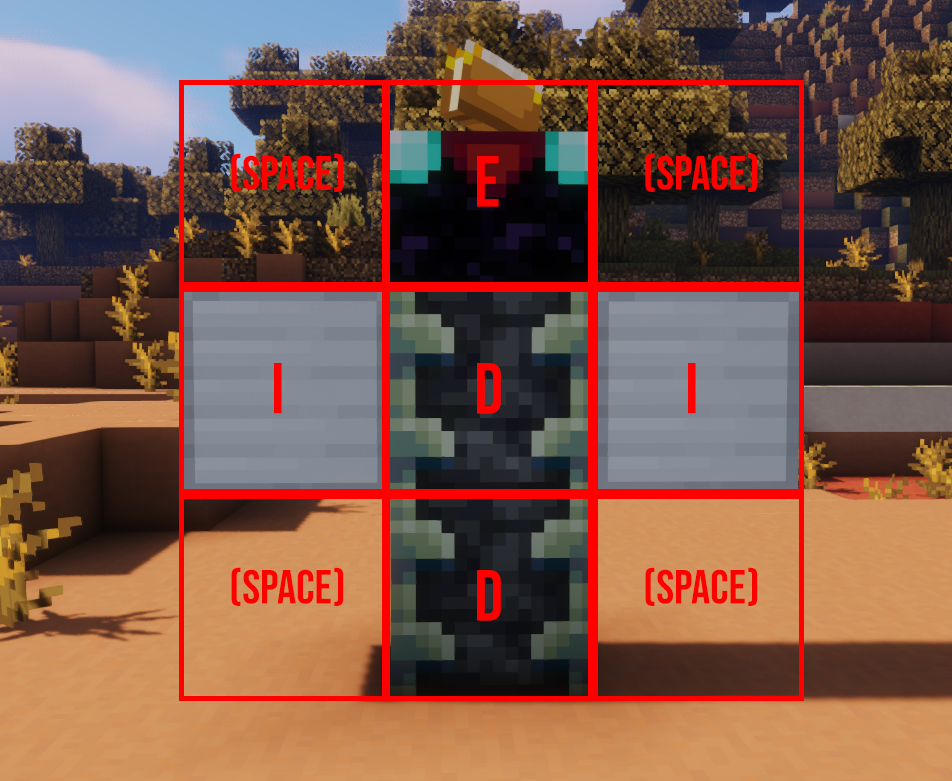
Here is a visual representation of how this pattern looks:
Because there's 3 lines, and 3 materials in each line, this is a 3x3 pattern. A very basic 2D pattern. You can have as many lines in height or width as you want.